As I mentioned, George had an IV upon arrival into the NICU, which is pretty common. Through this IV, he was given TPN (Total Parenteral Nutrition), which essentially gives newborns all the nutrients they need. George started feeding on day 1 of life and gradually increased his amounts. It’s not uncommon for babies to be born and present low blood sugars; however most times this is resolved within the first 24-36 hours of life. This wasn’t the case for George.
He had a glucose of 30 mg/dL upon birth and he was on dextrose which helped manage it. One night, a nurse decided to randomly take his levels and noted that they had dropped below the 50 mg/dL threshold. Even a premature baby was expected to maintain above these levels. His dextrose amount had to be increased and George was having his heels pricked every 3 hours prior to feeds. His levels were above the threshold for the following 2 days, so the attending doctor suggested to begin weaning him off dextrose. The first time they attempted to do so, they were extremely aggressive by halving the amount of dextrose which caused his levels to drop. We were back at square one. So, here was the plan they suggested. George started on an IV level of 9 and he had to go all the way down to 0, so for every feed his glucose was 70 mg/dL, he would go down one level. If he went two glucose checks 60 or higher, they’d take him down a level. However, if he hit a 50 or lower, he would have to go back up. Now if you do the math, George fed every 3 hours and he wasn’t hitting high numbers, so this took about 17 feeds as opposed to 9. On day 11 of life, he was finally off dextrose!

On day 16 of life, Endocrinology wanted to run a test in order to understand why George was having difficulty maintaining his blood sugars, so they decided they wanted to run a stimulation ACTH (adrenocorticotropic hormone) test. The purpose of this test was to ensure that his pituitary gland in his brain were communicating well with the adrenal gland. They would do this by checking his cortisol levels hourly when put under stress. Putting a baby under stress would involve placing in an IV, which was too difficult to watch. Along with this, endocrinology wanted to run a glucose challenge where they administered glycogen and skipped a feed to see how he would maintain his blood sugars. All in all, endocrinology made a mistake of not communicating to the team that the tests were not to be run simultaneously. The information they were able to obtain was that George’s glands were communicating properly. You can imagine our frustration with endocrinology, especially when we were told the next day that the glucose challenge had to be repeated. So on day 16 of life, George had his second glucose challenge, which came back inconclusive. We were informed that the results indicated that there was a suspicion of hyperinsulinism. Essentially, this would explain George’s high insulin production and low glucose levels.
At this point, endocrinology contacted CHOP for George’s management and it was decided that George needed to go on medication for hyperinsulinism. George was put on 10 mg/kg of Diazoxide on day 16 of life, as well as a diuretic to avoid the side of effects of potential fluid retention. When anyone begins a treatment on Diazoxide, they are expected to fast in order to understand how and if the medication is working. So, we were told that George was to do a fasting challenge. This meant that George would have to skip a feed and his glucose would get check every hour after the third hour. The expectation was for his glucose to stay above 70 at all times.
I’m sure you can sense this had already been an emotional journey for us and hearing that we would have to starve (okay, I know that’s a bit dramatic) George really broke me. On day 21, George failed to pass the fast. This meant that after a long conversation with doctors and CHOP, George’s dose of Diazoxide would be increased to 15 mg/kg. And on day 23, the diuretic was also increased. On day 24, George was to fast again and we had extremely high hopes of him going home because it was New Year’s eve and we expected amazing results because he was really close to passing the fast the previous time.
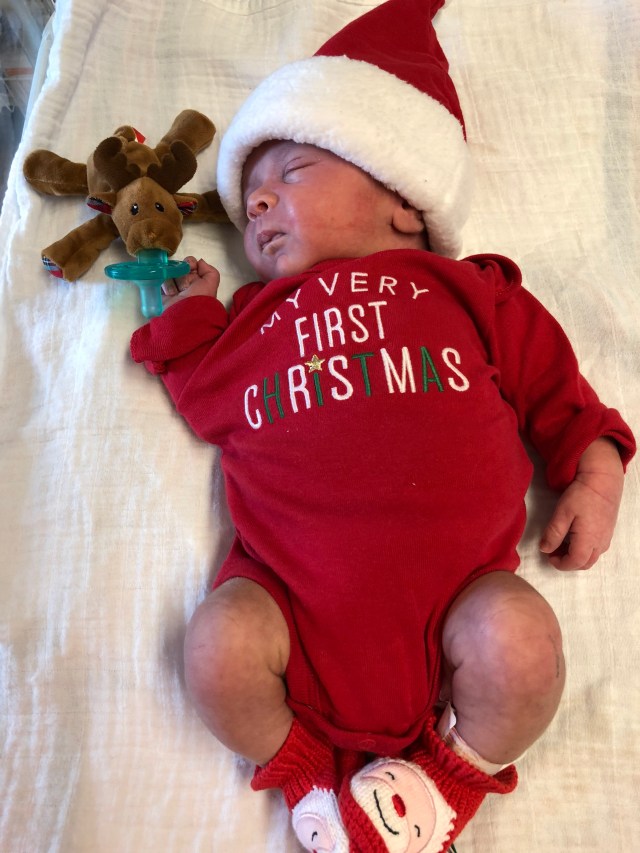
Let me remind you, George was born on December 7th, which means we did in fact spend Christmas in the hospital. My family celebrates Christmas eve, so on that day aunts, uncles and cousins came by with loads of food and gifts for us including, blankets and comfy leggings for our stay. My parents and sister came by later in the evening and stayed with us past midnight to eat and open gifts. We took pictures with Georgie and enjoyed our Christmas with our little miracle baby.
However, on day 24, George failed again.
My heart was in a million pieces and my head was so confused. A part of me wanted to just sign him out, so we could just enjoy our baby. Yet on the other hand, I wanted to understand why this was happening. I kept asking so many questions, but I had to swallow every inch of pain I felt to try to enjoy the fact that a new year was starting. I had to try my best to stay positive, no matter how broken I felt.

Doctors decided to wait another few days to make sure the medication had FULLY kicked in. At this point, we were frustrated to hear that we had to do another fast. Especially since we weren’t previously told that typically you should wait 4-5 days before Diazoxide fully kicks in. So, we continued to wait.
 My Curious Georgie